
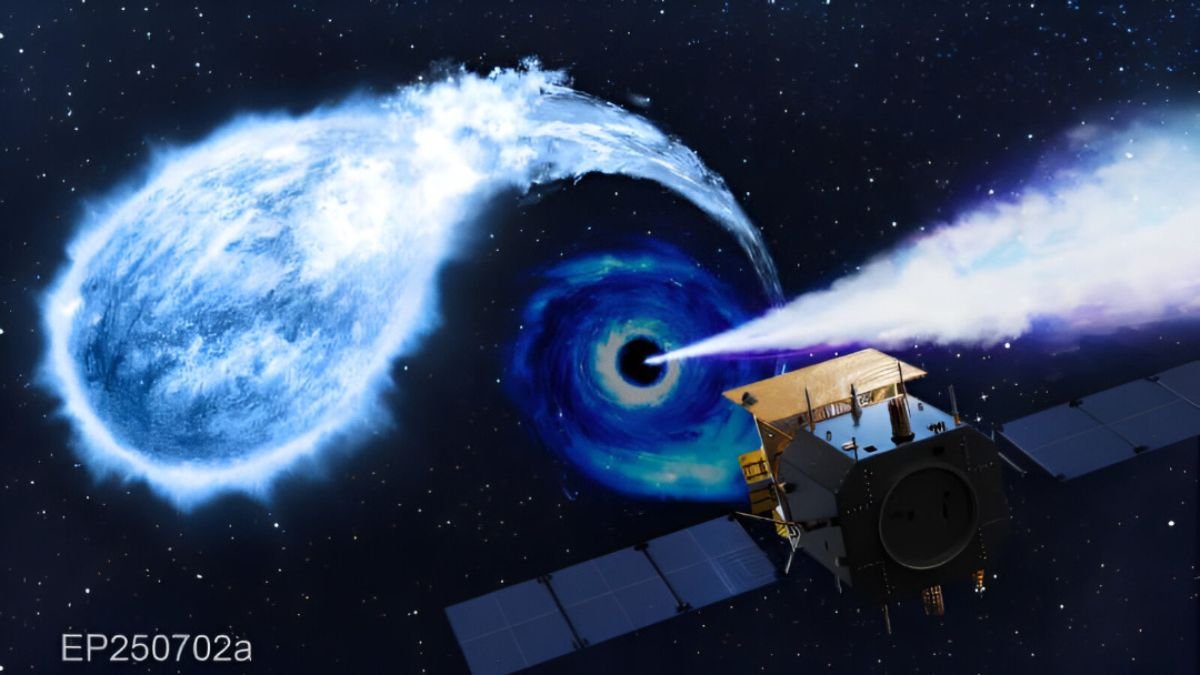
On July 2, 2025, a moment occurred in the world of space science that stunned astronomers. During its routine sky survey, the Chinese-led Einstein Probe (EP) space telescope detected an extremely bright and rapidly changing X-ray source. Normally, the brightness and behavior of X-ray sources visible in the universe follow a fixed pattern, but this time the signal was completely different. Its brightness fluctuated rapidly, indicating that an extremely energetic and rare event was occurring somewhere.
This unusual signal immediately alerted scientists. Many major observatories and space telescopes around the world were activated to study this phenomenon in detail. O estudo foi coordenado pelo Einstein Probe Science Center do National Astronomical Observatories of China (NAOC), com participação de numerosas instituições de pesquisa da China e do exterior. Astrophysicists from the Department of Physics at the University of Hong Kong (HKU), who are key members of the EP scientific team, were also actively involved in this research.
Based on preliminary analysis, scientists proposed that this event could possibly mark the moment when an intermediate-mass black hole, using its immense gravitational force, engulfed a white dwarf star. If this hypothesis proves correct, it would be the first time direct evidence of such a “black hole’s celestial appetite” has been found. This landmark discovery has been published as a cover story in the prestigious journal Science Bulletin.
[also_read id=”2469″]
A cosmic explosion completely different from the usual pattern
The Einstein Probe’s two specialized X-ray instruments played a key role in making this discovery possible. On July 2, 2025, during a routine survey, the Wide-Field X-ray Telescope (WXT) detected a transient X-ray source, which exhibited rapid and violent changes. It was later named EP250702a (or GRB 250702B). Around the same time, NASA’s Fermi Gamma-ray Space Telescope also recorded a gamma-ray burst from the same region of the sky.
However, the true significance of this event was revealed when scientists examined earlier data from WXT. They discovered that the gamma-ray burst had been preceded by continuous X-ray emission from the same location for about a day. This sequence is extremely rare, as gamma-ray bursts are usually observed first, followed by other radiation.
About 15 hours after the initial signal, the source erupted in intense X-ray flares. Its maximum brightness reached approximately 3 × 10⁴⁹ ergs per second, making it one of the brightest instantaneous events ever observed in the universe. According to Dr. Dongyu Li, lead author of the paper, said, “This initial X-ray signal is extremely important.” It clearly demonstrates that this was not a typical gamma-ray burst.”
A Changing Picture in 20 Days
The precise coordinates provided by WXT led observatories around the world to immediately begin multi-wavelength studies of the source. This confirmed that the event occurred in the outskirts of a distant galaxy, not at its core. This fact also makes it unusual, as most high-energy events are associated with supermassive black holes located at the centers of galaxies.
The EP’s second instrument, the Follow-Up X-ray Telescope (FXT), then studied the source for approximately 20 days. During this period, its brightness decreased more than a million-fold, and its X-ray emission changed from a high-energy (hard) state to a low-energy (soft) state.
When data from various telescopes was combined and analyzed, several features of the event were found to be inconsistent with existing theories. The X-ray emission preceding the gamma-ray burst, the extreme brightness, the rapid timescale, and its occurrence on the outskirts of the galaxy—all pointing to a new or rare scenario. Ultimately, scientists concluded that this was likely the destruction of a white dwarf star by an intermediate-mass black hole.
[also_read id=”2313″]
The Role of Theory and Computational Modeling
The team from the University of Hong Kong played a key role in understanding this mystery. Professor Lixin Dai explained that the white dwarf–intermediate-mass black hole model could most naturally explain the intensity and energy of this phenomenon.
Dr. Jinhong Chen, through advanced computer simulations, showed that when a dense white dwarf star is gravitationally affected by an intermediate-mass black hole, the tidal forces generated tear it apart. This process releases enormous energy and can create a relativistic jet, which is consistent with the observed data.
Professor Bing Zhang described this discovery as an excellent example of global collaboration. According to him, the intense discussion among scientists from different countries and the testing of competing theories further enhances the scientific significance of this discovery.
Why is this discovery important?
If future studies confirm this finding, it will be the first time scientists have direct evidence of the existence and behavior of intermediate-mass black holes. Until now, only two major classes of black holes had been clearly observed—small stellar-mass black holes and extremely massive supermassive black holes. Intermediate-mass black holes have long been considered the “missing link.”
This discovery could open new avenues for understanding the accretion process of black holes, the ultimate fate of compact stars, and the field of multi-messenger astronomy. It will also help us understand how extreme conditions develop and how energy is distributed in the universe.
Conclusion: A glimpse into the universe’s most extreme moments
The Einstein Probe mission aims to capture unexpected and extreme astronomical events. The discovery of EP250702a is proof that, through modern technology and global collaboration, we are rapidly advancing towards understanding the universe’s most mysterious moments.
This event is not just a scientific discovery, but a symbol of the power of human curiosity and research. More observations and analyses in the coming years will further elucidate this mystery. If this hypothesis proves true, this discovery will prove to be a milestone in the history of astronomy and will take us closer to the mysterious secrets of the universe.