
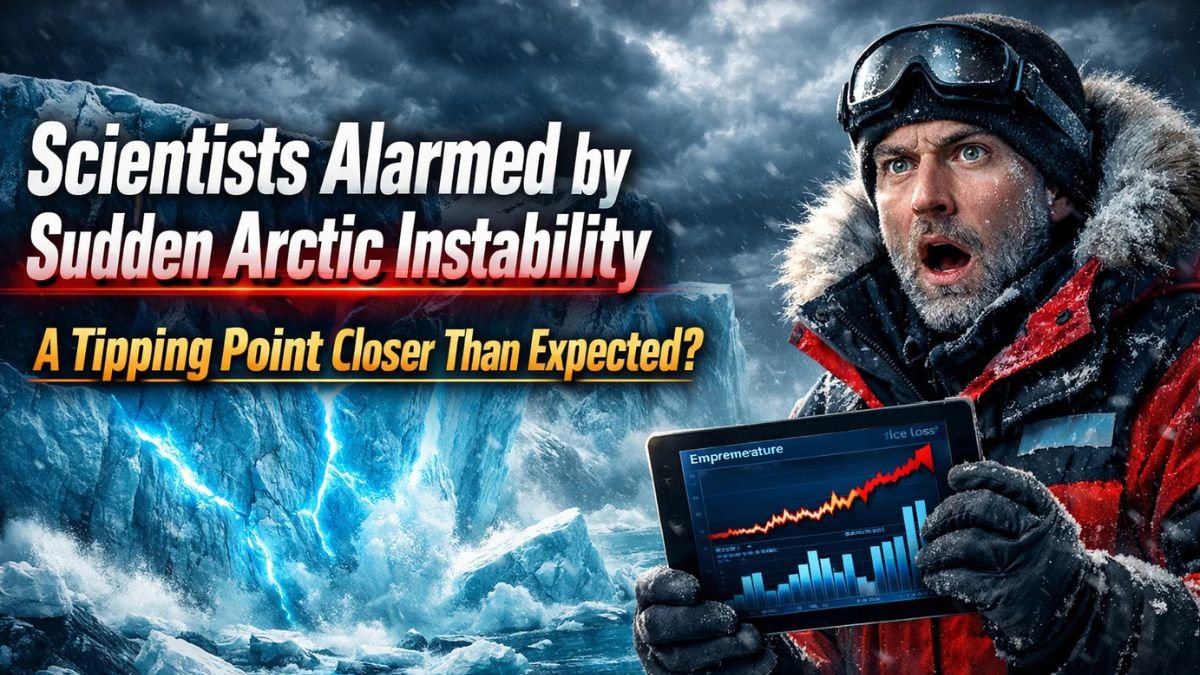
Scientists Alarmed by Sudden Arctic Instability – Standing on the deck of an icebreaker, the world sounds different. February usually resounds with the dry, sharp sound of sea ice breaking up, the creaking of boots on frozen ice at -30°C. But this time, the scene is different. A thin layer of meltwater glistens in the hazy Arctic evening, and the ice makes a sound like an old wooden floor about to crack. A marine biologist kneels down to take a water sample. Her brow furrows as the thermometer hovers above zero—“Early February?” she mutters to herself. Nearby, a meteorologist is looking at satellite maps on a laptop, showing red hot streaks stretching across the polar darkness.
No one says it out loud, but everyone has the same question—has Arctic weather run its course?
When Winter Covers Spring
From northern Norway to the Chukchi Sea, meteorologists are seeing charts that look like April, not deep winter. The cold Arctic air that once held the Northern Hemisphere in its grip now seems to have dissipated. Currents of warm, moist air from the Atlantic and Pacific Oceans are moving upward, and this February, temperatures in some areas were recorded 10 to 15 degrees Celsius above normal.
These figures don’t just remain on paper. On the ground, they mean rain—where it should be snowing, it’s falling. On the small island of Svalbard, reindeer are gliding across a layer of snow that shouldn’t have formed yet. Warm air and then frozen rain have sealed the lichens (mosses), their staple food, under glassy ice. Local scientists say they’ve seen this before, but never so often and so quickly.
To the east, weather sensors in the Russian Arctic are repeatedly sending data that were once considered rare exceptions. Now, they’re occurring weekly. This is no coincidence, but a recurring pattern.
[also_read id=”2607″]
A Fluctuating Polar Vortex and Thinning Ice
In meteorological terms, this is called “Arctic instability.” A major cause is the polar vortex, which used to stabilize the Arctic cold by forming a barrier of cold air at high altitudes. Now, this vortex is oscillating more than ever. Waves of warm air are breaking through this barrier, causing sea ice to thin to record levels in February.
The problem isn’t just the thickness of the ice. The real concern is that when a system that used to remain stable year after year suddenly swings, life doesn’t have time to recover.
Threats to Biological Balance: The Rising of a “Biological Tipping Point”
If you ask Arctic ecologists what worries them most, they won’t just mention polar bears. They’ll mention microscopic plankton, precocious algae blooms, and early insects emerging along tundra rivers. These tiny creatures have relied on daylength, ice thickness, and temperature signals for millions of years. When February begins to resemble March, these signals are disrupted.
A research team in northern Alaska found that meltwater had formed in the soil beneath the snow. Microbes had become active, breaking down frozen organic matter, releasing carbon dioxide and methane. Some shrubs were triggered by unusual warmth, but when the cold returned, those shoots died.
This is what scientists call a “biological tipping point”—a moment when repeated timing errors throw the entire food chain out of balance. If plankton spawn prematurely and the algae they feed on haven’t yet grown, fish will starve. If seabird chicks are born after their peak feeding season, their survival becomes difficult.
Scientists’ Race: Trying to Decipher New Signals
Researchers are changing their strategies to understand this changing Arctic. Expeditions that previously began in spring are now being extended into February. Drones are monitoring open water cracks in the sea ice. Underwater instruments are recording temperature and nutrient changes.
The goal now is not just to record changes, but to capture the moment when temperature, ice, and life form converge into a new pattern. Many scientists admit that this is also mentally challenging. “Climate grief” has now become a real experience.
Yet they stick to certain principles—focusing on a key signal, openly discussing emotions within the team, and considering every small piece of data collection as crucial to future decisions.
[also_read id=”2610″]
Impacts Thousands of Kilometers Beyond the Arctic
This Arctic instability isn’t limited to the North Pole. The same distorted jet stream, which carries warm air to the pole, can cause unusual cold or irregular storms in other parts of the world. The Arctic isn’t a distant story, but a vital part of Earth’s climate system.
If the biological and climatic balance here shifts, it could impact food prices, coastal flooding, and even allergy season. Every unusual winter reduces another layer of our protective shield.
Conclusion: A Burning Beacon of Warning
February was once considered the safest and most stable time in the Arctic. Now, that very month appears to be a warning. The question isn’t whether change is occurring— That’s clear. The real question is whether we’re still past the point of no return, or whether we’re on the threshold of a new Arctic era.
The silence of scientists standing on the Arctic ice speaks volumes. This isn’t just a temperature record, but a story of nature losing its rhythm. And when the rhythm breaks, the impact isn’t limited to the poles—it’s felt across the globe.